IA Generativa
MichiAI: Revolutionizing Real-Time Speech Interaction with 75ms Latency
Dr. Adrian Vale
LLM, AI Agents & AI Infrastructure Specialist
6 min read
Listen to Article
AI automated narration
LLM, AI Agents & AI Infrastructure Specialist
MichiAI offers full-duplex speech interactions, revolutionizing communication with a remarkable 75ms latency. This technology enhances user experience, making interactions smoother and more efficient across various sectors.
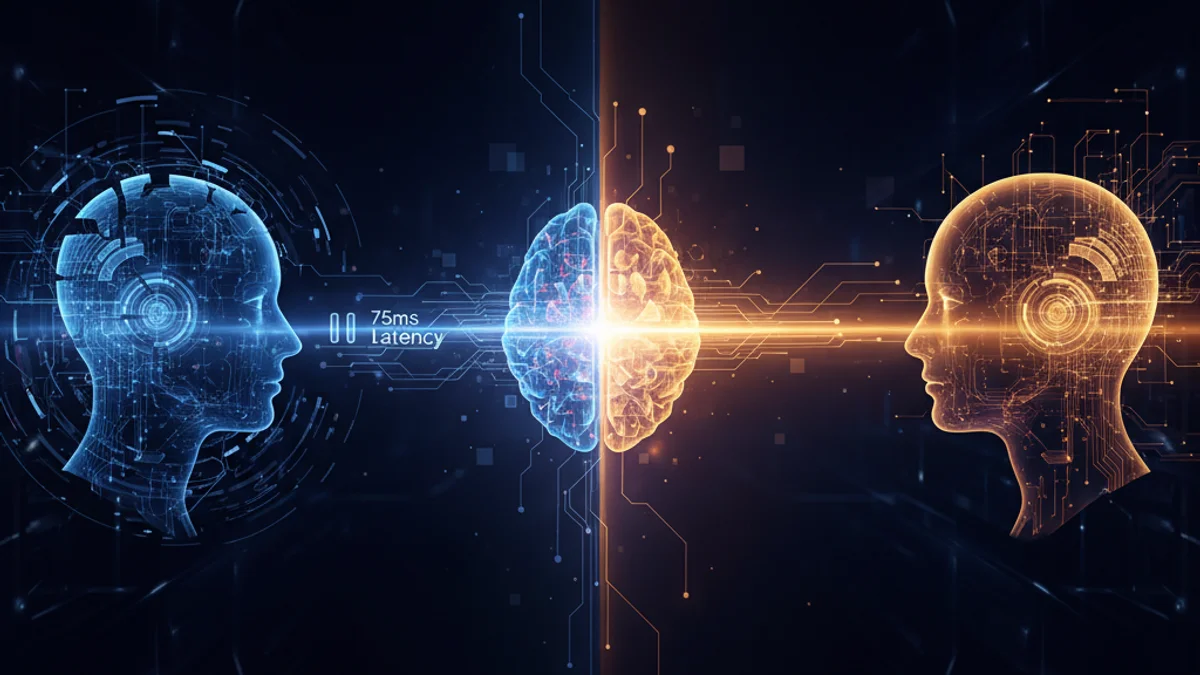
In the ever-evolving field of artificial intelligence, the way humans interact with machines has seen remarkable advancements. From text-based interfaces to voice-controlled systems, the goal has always been to bridge the gap between human and machine communication. MichiAI, a state-of-the-art full-duplex speech language model (LLM), is the latest innovation to take this interaction to the next level. With an impressive latency of just 75 milliseconds (ms), MichiAI is setting new standards for real-time, natural speech exchanges.
This article delves into MichiAI's groundbreaking technology, its underlying mechanisms, real-world applications, and the potential impact it holds for AI-driven communication systems.
At its core, MichiAI is designed to emulate human-like conversation by enabling simultaneous speaking and listening, a capability known as full-duplex communication. Unlike traditional systems that operate in a turn-based manner, MichiAI achieves fluid, real-time interaction through a sophisticated architecture. Here are the critical components that drive its revolutionary performance:
Perception Modules: These modules are responsible for instantly capturing user speech. By leveraging advanced speech recognition algorithms, MichiAI can accurately process spoken words in real-time, even in noisy environments.
Motor Modules: Once the perception module processes the input, the motor modules generate swift, contextually appropriate responses. The system’s low 75ms latency allows it to respond almost instantaneously, ensuring a seamless conversational flow.
Neural Finite State Machine (NFSM): This component governs the dialogue flow. By managing contextual understanding and response timing, the NFSM ensures that interruptions, pauses, and overlaps in conversation mimic natural human dialogue patterns. This feature is particularly critical for applications like customer service and virtual assistants, where timing is everything.
Optimization Through Large Language Models (LLMs): MichiAI is built upon advanced LLMs, which are trained on vast datasets to understand complex queries, generate nuanced responses, and adapt to various conversational contexts. The integration of LLMs allows MichiAI to interpret intent, sentiment, and even subtle conversational cues.
By combining these components, MichiAI delivers a level of interaction that feels genuinely human, setting it apart from traditional voice-controlled systems.
The versatility of MichiAI makes it an invaluable tool across a wide range of industries. Below are some of the most promising use cases:
MichiAI can significantly enhance the capabilities of virtual assistants like Siri, Alexa, and Google Assistant. With its ultra-low latency and full-duplex communication, users can engage in seamless, natural conversations without awkward pauses or delays. This is particularly useful for multitasking scenarios where users need hands-free, real-time assistance.
In customer service, every second counts. MichiAI’s ability to respond in just 75ms can drastically reduce wait times and improve overall user satisfaction. The system’s natural dialogue capabilities also make it easier for users to explain their issues while receiving instant, context-aware responses.
In telemedicine, communication efficiency can directly impact patient outcomes. MichiAI’s real-time interaction capability allows healthcare providers to gather patient information and provide advice without delays or misunderstandings, enhancing the quality of remote consultations.
MichiAI can serve as an intelligent tutor, offering students real-time feedback and explanations during virtual learning sessions. Its ability to understand and respond to complex queries makes it an ideal tool for personalized education.
For individuals with disabilities, MichiAI can act as a vital communication aid. Its real-time speech recognition and response capabilities can help bridge communication gaps, providing greater independence and improved quality of life.
One of MichiAI’s most striking features is its 75ms latency, a benchmark that redefines what’s possible in machine-human communication. To put this into perspective, the average human response time in a live conversation is approximately 200ms. MichiAI’s ability to respond in less than half that time creates an almost imperceptible gap between a user’s input and the system’s reply.
Natural Flow of Conversation: By minimizing delays, MichiAI eliminates the awkward pauses typically associated with AI-driven interactions. This makes the user feel as though they are speaking to another human rather than a machine.
Improved User Experience: Faster response times reduce user frustration, making interactions more engaging and enjoyable. This is especially important in high-stress situations like customer support or emergency services.
Enhanced Multitasking: In scenarios where users need to interact with the system while performing other tasks, such as driving or cooking, the low latency ensures that the interaction doesn’t disrupt their flow.
Better Context Management: The reduced delay allows MichiAI to maintain context more effectively, resulting in more coherent and meaningful conversations.
While MichiAI represents a significant leap forward, there are challenges that need to be addressed to unlock its full potential:
Scalability: Integrating MichiAI into large-scale systems, such as call centers with thousands of simultaneous users, requires robust infrastructure and optimization.
Data Privacy: As with any AI system, the collection and processing of user data raise concerns about privacy and security. Ensuring compliance with data protection regulations, such as GDPR, will be critical.
Cultural and Linguistic Diversity: For MichiAI to be truly global, it must support multiple languages and adapt to various cultural nuances in communication.
Despite these challenges, the future looks promising. Advances in AI, machine learning, and natural language processing are likely to further enhance MichiAI’s capabilities, making it even more versatile and impactful.
MichiAI is not just a technological breakthrough; it’s a paradigm shift in how humans interact with machines. Its ability to deliver full-duplex speech interaction with an industry-leading latency of 75ms sets a new benchmark for AI-driven communication systems. Whether it’s used in virtual assistants, customer service, healthcare, or education, MichiAI promises to make interactions faster, more natural, and more satisfying.
As businesses and developers explore its potential, MichiAI could become the cornerstone of next-generation communication technologies. By addressing challenges like scalability and data privacy while continuing to innovate, MichiAI has the potential to redefine human-machine interaction for years to come.
For those looking to stay ahead in the AI landscape, integrating MichiAI into their systems could be a game-changer. The era of seamless, real-time communication is here, and MichiAI is leading the way.
💡 Pro Tip: Developers can explore MichiAI’s API to integrate real-time speech capabilities into their applications, enhancing user experience across a variety of platforms.