Startups & Inovação
Was Nvidia's $100 Billion Investment in OpenAI Just a Mirage?
Dr. Adrian Vale
LLM, AI Agents & AI Infrastructure Specialist
6 min read
Listen to Article
AI automated narration
LLM, AI Agents & AI Infrastructure Specialist
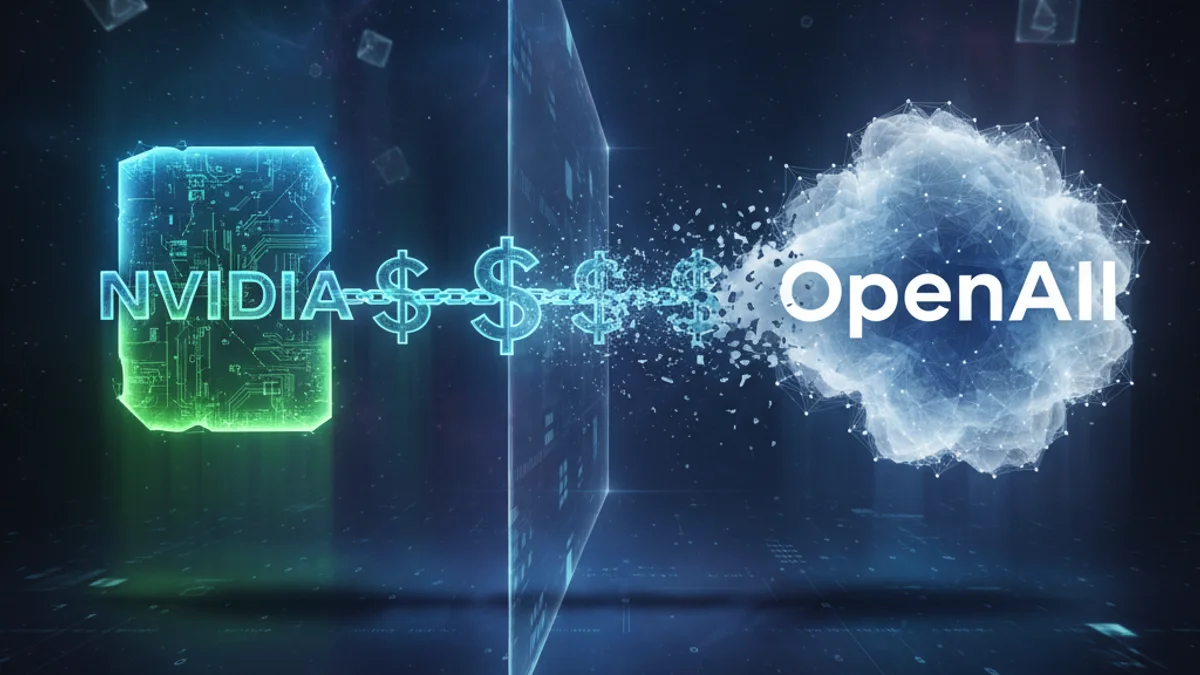
Nvidia's CEO, Jensen Huang, revealed that the $100 billion investment in OpenAI was never a formal commitment. This revelation could shake investor confidence and reshape the AI landscape.
The intersection of artificial intelligence and big tech investments has been a hotbed of speculation, especially with Nvidia at the forefront of this evolving industry. Recently, Jensen Huang, CEO of Nvidia, made a statement that sent shockwaves through the AI community and financial markets. According to Huang, the much-publicized $100 billion investment in OpenAI was not a genuine commitment. This revelation raises critical questions about Nvidia's financial strategies, its role in the AI ecosystem, and the broader implications for the industry.
Over the past decade, Nvidia has become synonymous with AI development, thanks to its cutting-edge GPUs and significant contributions to machine learning frameworks. When reports surfaced of a potential $100 billion investment in OpenAI—one of the leading players in the AI field—many saw this as a natural progression of Nvidia's dominance. OpenAI, known for developing transformative technologies like GPT-4, has relied heavily on high-performance GPUs, many of which are produced by Nvidia.
However, Huang's recent statement, "It was never a commitment," has cast doubt on the nature of Nvidia's involvement and its strategic intentions. This clarification suggests that while Nvidia may have engaged in discussions or expressed interest in funding OpenAI, no formal agreement or binding commitment was made. Rather, the company appears to be adopting a more cautious, case-by-case approach to its investments.
This revelation has led to widespread speculation about the reasons behind Nvidia's hesitancy to solidify its financial support for OpenAI. Was it a strategic decision to maintain flexibility in resource allocation? Or does it reflect a broader concern about the long-term prospects of AI companies in an increasingly crowded and competitive market?
Huang's remarks have not only raised questions about Nvidia's strategy but also sparked broader concerns about the stability and direction of the AI market. The potential ripple effects of this announcement are significant, touching on several key areas:
The AI sector is heavily reliant on investor trust and optimism. For years, Nvidia has been a darling of the stock market, with its shares surging thanks to its pivotal role in enabling AI technologies. However, the lack of a clear commitment to OpenAI could erode some of that confidence. Investors may begin to question whether Nvidia is as bullish on AI as it has appeared, or if it is hedging its bets in light of potential market volatility.
Nvidia's competitors, such as AMD and Intel, have been making strides to capture a larger share of the AI hardware market. Meanwhile, tech giants like Google, Microsoft, and Amazon have made substantial financial commitments to AI research and development, often through acquisitions or partnerships. Nvidia's cautious stance could be perceived as a disadvantage in the race to dominate the AI industry.
The AI sector is already experiencing significant fluctuations, with some analysts warning of a potential bubble. Huang's statement could exacerbate these concerns, as it underscores the uncertainty surrounding major investments in AI. If companies like Nvidia, which have been at the forefront of AI innovation, are hesitant to commit fully, it could signal a broader re-evaluation of the sector's growth potential.
While Huang's comments may have raised eyebrows, they also reflect a level of prudence that could ultimately benefit Nvidia. The AI market is evolving rapidly, and committing $100 billion to a single entity—even one as prominent as OpenAI—carries significant risks. By taking a more measured approach, Nvidia may be positioning itself to adapt to changes in the market landscape and allocate resources more effectively.
Rather than tying up a massive amount of capital in a single partnership, Nvidia may choose to spread its investments across multiple AI initiatives. This strategy could reduce risk and allow the company to support a broader range of innovative projects, potentially leading to a more diverse and resilient portfolio.
The AI industry is not monolithic; it encompasses a wide array of technologies, from natural language processing to autonomous vehicles. By keeping its options open, Nvidia can pivot its focus to areas that show the most promise or align with its core competencies.
In a market as dynamic as AI, flexibility is a valuable asset. Nvidia's decision to avoid a binding commitment to OpenAI may provide the company with the agility needed to respond to unforeseen challenges or opportunities.
The controversy surrounding Nvidia's investment strategy is emblematic of the broader challenges facing the AI industry. While the sector has witnessed unprecedented growth and innovation, it is also grappling with significant hurdles, including ethical concerns, regulatory scrutiny, and the need for sustainable business models.
As AI technologies become more advanced, they raise complex ethical questions about privacy, bias, and accountability. Companies like Nvidia and OpenAI are not only competing to develop the most advanced AI systems but also navigating a rapidly evolving regulatory landscape. This adds another layer of complexity to investment decisions.
The AI market is becoming increasingly crowded, with new players entering the field and existing tech giants ramping up their efforts. This competition is driving innovation but also creating pressure on companies to deliver tangible results. Nvidia's cautious approach may be a response to this heightened competition, as it seeks to maintain its leadership position without overextending itself.
The rapid pace of AI development has led to concerns about the sustainability of current business models. High-profile investments often come with high expectations, and companies must balance the need for growth with the imperative to build long-term, sustainable value. Nvidia's decision to avoid a formal commitment to OpenAI could be seen as an effort to strike this balance.
Jensen Huang's revelation about Nvidia's non-commitment to a $100 billion investment in OpenAI has sparked significant debate and speculation. While some view this as a sign of wavering confidence, others see it as a strategic move to maintain flexibility and adapt to a rapidly changing market. Regardless of the interpretation, the announcement highlights the challenges and uncertainties facing the AI industry as it enters a critical phase of development.
For Nvidia, the path forward will require clear communication with investors and stakeholders, as well as a thoughtful approach to resource allocation. The company has long been a leader in the AI space, and its decisions will undoubtedly influence the industry's trajectory. As the market continues to evolve, all eyes will be on Nvidia to see how it navigates this complex and high-stakes landscape.