Big Tech
What’s Really Behind the OpenAI-Nvidia $100 Billion Deal?
Dr. Adrian Vale
LLM, AI Agents & AI Infrastructure Specialist
6 min read
Listen to Article
AI automated narration
LLM, AI Agents & AI Infrastructure Specialist
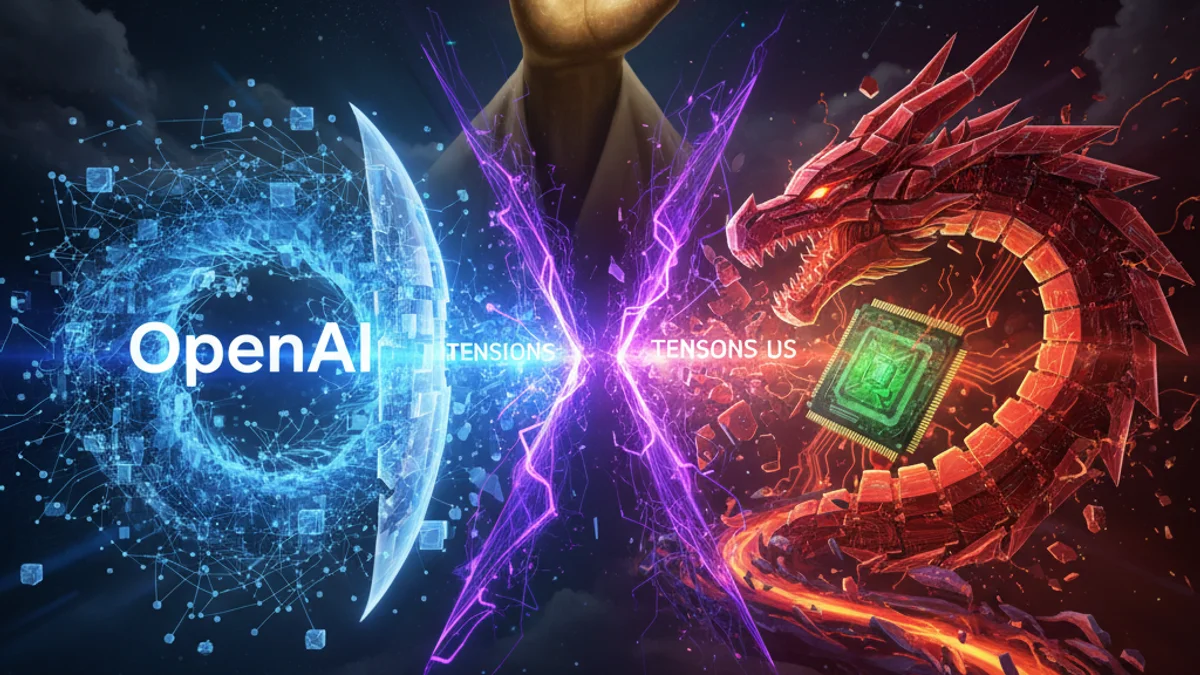
The $100 billion partnership between OpenAI and Nvidia faces significant internal tensions that could reshape AI development. Understanding these dynamics is crucial for anticipating future innovations and market shifts.
In January 2026, the technology world was shaken by the announcement of a $100 billion partnership between OpenAI and Nvidia—a collaboration that promised to redefine the artificial intelligence (AI) landscape. The agreement aimed to leverage Nvidia’s unparalleled hardware expertise and OpenAI’s groundbreaking advancements in generative AI to push the frontiers of innovation. However, beneath the surface of this historic deal lies a web of challenges, rivalries, and potential roadblocks that could dramatically influence the future of artificial intelligence.
The partnership between OpenAI and Nvidia is monumental in both scale and ambition. Nvidia, known as the leader in AI-focused GPUs (Graphics Processing Units), has been instrumental in accelerating AI research and development globally. Its GPUs are the backbone of many AI models, including OpenAI’s ChatGPT and DALL-E.
OpenAI, on the other hand, has emerged as a trailblazer in generative AI technologies, introducing transformative tools like GPT-4 and Codex. The partnership between these two entities was seen as a natural evolution—an alliance that would combine Nvidia’s hardware dominance with OpenAI’s software innovation to tackle the growing demand for AI-powered tools and applications.
The $100 billion deal reportedly involves Nvidia supplying advanced chips and computational infrastructure to OpenAI, while OpenAI leverages this hardware to develop increasingly sophisticated AI models. This symbiotic relationship aims to democratize AI applications across industries, from healthcare and education to gaming and autonomous vehicles.
However, while the potential benefits of the partnership are immense, cracks in the relationship have already begun to emerge. These challenges, if unresolved, could have far-reaching consequences for both companies and the broader AI ecosystem.
One of the most significant points of contention in this partnership comes from Nvidia’s CEO, Jensen Huang. Known for his visionary leadership and sharp business acumen, Huang has openly criticized OpenAI’s operational practices, describing them as lacking in ‘business discipline.’
Huang’s concerns reportedly stem from OpenAI’s rapid scaling efforts, which some insiders have described as chaotic and financially unsustainable. As OpenAI continues to expand its suite of AI products, the company has faced mounting pressure to monetize its technologies while maintaining ethical standards and high-quality outputs. Huang’s critique suggests that Nvidia may be wary of the financial risks associated with OpenAI’s aggressive growth strategy.
This public criticism has raised questions about the long-term viability of the partnership. Can OpenAI address Nvidia’s concerns without compromising its innovative spirit? Or will these tensions lead to a breakdown in collaboration, forcing each company to seek alternative alliances?
The OpenAI-Nvidia partnership also exists within the context of a fiercely competitive AI landscape. Rival companies like Google, Microsoft, and Anthropic have been investing heavily in AI research, creating a high-stakes race for dominance in the sector.
Google, through its DeepMind division, has been a pioneer in AI research, developing revolutionary technologies like AlphaFold for protein folding and Bard, its answer to OpenAI’s ChatGPT. Meanwhile, Microsoft has deepened its ties with OpenAI, integrating GPT models into its Azure cloud platform and Office suite to enhance productivity tools like Word and Excel.
Anthropic, a newer player in the AI space, has also gained attention for its focus on safety and ethics in AI development. With significant funding and a rapidly growing team, Anthropic poses a direct challenge to OpenAI’s leadership in the generative AI market.
This competitive pressure has forced companies to innovate at breakneck speed, but it has also introduced risks. Partnerships like the one between OpenAI and Nvidia must navigate not only internal challenges but also external threats from rivals eager to capitalize on any misstep.
The tensions between OpenAI and Nvidia have implications that extend far beyond the two companies. The outcome of this partnership will likely shape the trajectory of AI development for years to come. Here are some potential scenarios:
Huang’s criticism could prompt OpenAI to adopt stricter financial controls and more rigorous project management practices. While this might improve efficiency, it could also stifle the company’s capacity for bold, experimental innovation—a hallmark of its success thus far.
Delays or disruptions in the partnership could slow the rollout of new AI technologies, affecting millions of users who depend on OpenAI’s tools for business, education, and personal use. Additionally, uncertainty about the partnership’s future might erode trust among developers and enterprises relying on Nvidia and OpenAI for their AI needs.
The challenges facing OpenAI and Nvidia could serve as a cautionary tale for other companies in the AI sector. We may see increased emphasis on sustainable growth, transparent leadership, and collaborative innovation as firms seek to avoid similar pitfalls. Alternatively, the competitive landscape could drive firms to form new alliances, further fragmenting the industry.
The $100 billion partnership between OpenAI and Nvidia represents both a tremendous opportunity and a significant risk for the future of artificial intelligence. While the collaboration has the potential to accelerate innovation and democratize access to advanced AI technologies, internal tensions and external competition could undermine its success.
Jensen Huang’s criticisms highlight the delicate balance that must be struck between rapid innovation and sustainable growth. For OpenAI, addressing these concerns will be crucial not only for maintaining its partnership with Nvidia but also for preserving its reputation as a leader in the AI space.
At the same time, the broader AI industry will be watching closely. The outcome of this partnership could set a precedent for how tech giants collaborate in an increasingly competitive and high-stakes environment. Will OpenAI and Nvidia overcome their differences to achieve their shared vision, or will their partnership become a cautionary tale of ambition outpacing execution?
As the story unfolds, one thing is clear: the stakes have never been higher. The future of AI—and its impact on industries, societies, and economies worldwide—may very well rest on the success of this unprecedented collaboration.